README
Ruby and Oswald Photograph Reconstruction
experimentNo. 0017categoryHistory & trainingrecordingpendingdataCC BY 4.0
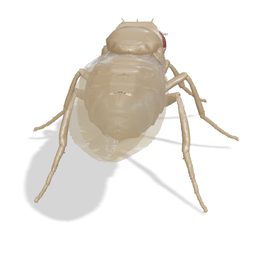
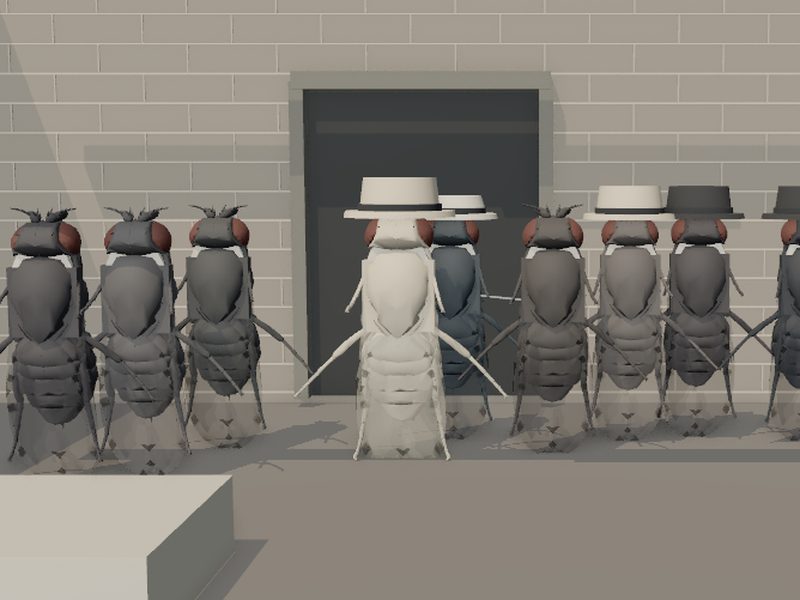
The fly occupies Jack Ruby's position in a non-graphic, all-fly reconstruction of Bob Jackson's published photograph; an external readout of measured neural rates selects the lateral endpoint of a pre-programmed, slowed projectile.
Recording pending publication. Follow along for the release.
Setup
- Figure assignments: the fly in Ruby's position, with flies for Oswald, Leavelle, Graves, the peaked-cap officer, the microphone holder, and obscured or edge figures with positional labels.
- Brickwork, doorway, partial car hood, hats and clothing accents approximate the photograph; cameras frame the Jackson composition, the hallway, the held object and the escort group.
- The Oswald figure and escorts move together; the Ruby figure flies forward holding a model object at the front-right tarsus, and the deliberately slowed projectile is followed by a small recoil pose without wounds.
- Scene variation shifts the escort group; controls train the readout, test the frozen readout and demonstrate the pre-programmed action.
Measurement
- Each of four training variations captures a 32 × 18 scene image; its 32 column luminance means are submitted as retinal-only input for three 100 ms bins, with paired connected and disconnected branches.
- An external nearest-example regressor reads six downstream population rates and selects one lateral endpoint; tests use a frozen readout and separate noise seeds.
- All other motion, timing and the projectile path are pre-programmed; neural weights never change.
Limitations
- Not a surveyed reconstruction; unidentified figures use positional labels, and no identities are assigned without a source.
- No ballistics, real firearm operation or aiming instruction is modeled.
- Results are single trials; no learning advantage is established.