README
Nutty Putty Cave Entrapment (2009)
experimentNo. 0047categoryRides & explorationrecordingpendingdataCC BY 4.0
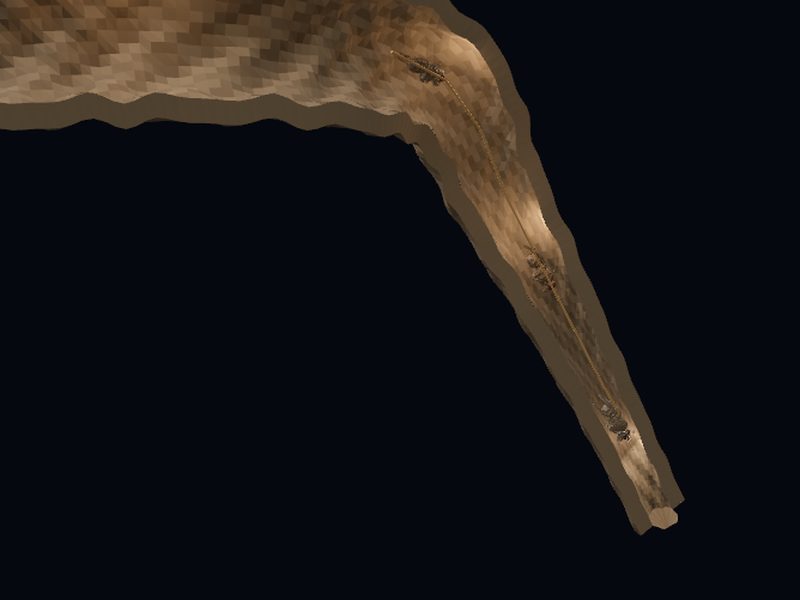
In a fly-scale limestone passage, the fly crawls through a left-hand bend and descends head-first into a steep squeeze, where it becomes wedged; two rescuer flies reach it and attempt a short haul.
Recording pending publication. Follow along for the release.
Setup
- Eight seekable stages over 150 seconds: crawlway, left bend, descent, entrapment, rescuers, a short upward haul, a setback and a final stationary hold.
- The scene is based on the November 24–25, 2009 entrapment of John Edward Jones, who died after the rescue effort; the cave was subsequently sealed.
- Two anatomical rescuer flies and a simple haul line condense the rescue sequence; the final stage holds the wedged fly without an injury or death animation.
- Cave and constriction cutaway cameras remove the near wall for display only; the trapped-fly POV and rescuer cameras retain both walls.
- Loop is off by default; a replay control starts at the descent.
Measurement
- Only rendered retinal columns reach the fixed connectome model; the eye image always retains the complete, closed cave.
- Movement and rope tension are pre-programmed; there is no contact solver, distress model or learned escape behavior.
Limitations
- An original fly-scale passage, not a cave survey; passage dimensions, lamp positions, figures, motion, timing and rope geometry are approximations.
- The actual pulley system is not reconstructed; contemporary reports use differing passage names, so stages carry descriptive labels.