README
Obedience Study Reconstruction (Milgram, 1963)
experimentNo. 0065categoryHistory & trainingrecordingpendingdataCC BY 4.0
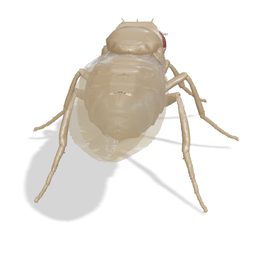
The fly serves as the teacher in a fly-based reconstruction of Stanley Milgram's 1961–62 Yale obedience experiments, reading word pairs and pressing switches on a simulated shock generator while an experimenter fly gives the four standardized prods.
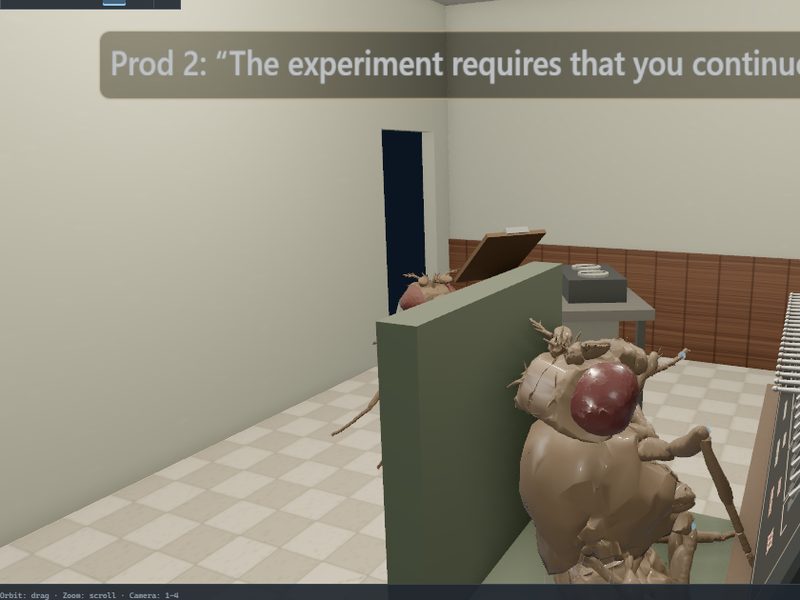
Recording pending publication. Follow along for the release.
Setup
- Eleven seekable stages over 182 seconds, from arrival and the rigged drawing through the 45-volt sample, escalation, the 300-volt point, the four prods and the XXX switches to the debrief.
- Five selectable conditions as published: remote feedback, voice feedback, proximity, touch-proximity and the new basement baseline.
- A 30-switch generator up to 450 V carries the published verbal designations; the four prods follow Milgram (1963) verbatim.
- Six cameras, including the generator panel, a cutaway of both rooms, the learner's chair, the experimenter and a plan view.
- Captions showing prods, voltages and condition notes are viewport-only and never part of the retinal image.
Measurement
- Retinal-only live input reaches the fixed connectome model; measured spikes drive the neural display.
- Whether the teacher fly continues or breaks off is pre-programmed and set by a user-selected stop voltage (15–450 V); it is not a decision computed by the connectome.
Limitations
- As in the original, the generator is a simulation and the learner is a confederate: no shock ever reaches the learner.
- Published completion counts for each condition (n = 40 each) are shown as reference values; the teacher fly's pre-programmed behavior does not reproduce or test them.