README
The Ludovico Technique
experimentNo. 0053categoryFilm & mediarecordingpendingdataCC BY 4.0
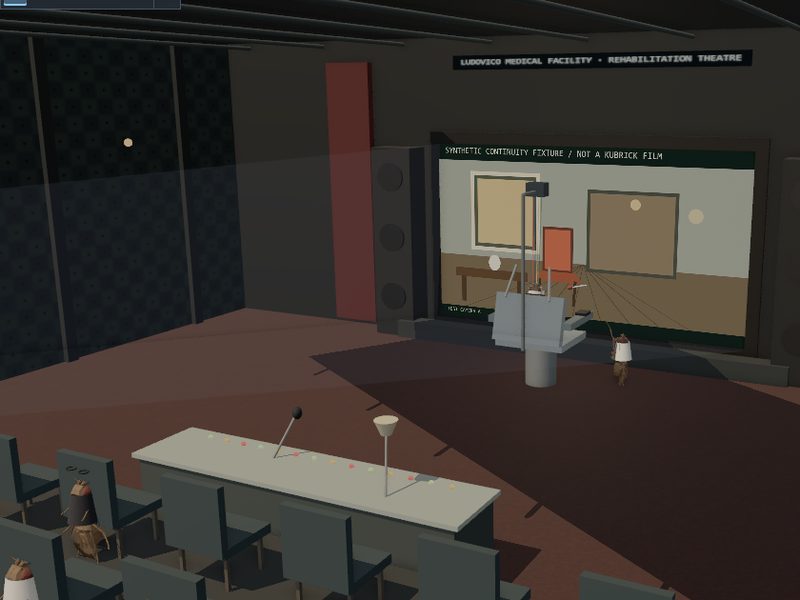
The fly is seated in a restraint chair facing a projection screen that plays any selected YouTube video or locally prepared film. Each screened frame reaches the connectome model as 32 luminance columns.
Recording pending publication. Follow along for the release.
Setup
- Procedural screening room modeled on the Ludovico sequence of A Clockwork Orange (1971): restraint chair, large screen, projection booth and tiered observer seating.
- An attendant fly applies eye drops on a fixed schedule; physicians and a recording technician watch from behind a console.
- Media source: a YouTube URL, reduced to an 11-character video ID and prepared at up to 720p, or any film in the local films folder. Live streams and videos longer than six hours are refused.
- Controls: transport, speed 0.25-2x, loop, monitor sound (muted by default), restraints, eye drops and framing (screen fills the eye, or seated in the room).
- Six cameras: screening room, subject, eyes and lid locks, over-the-shoulder, observers and projection booth.
Measurement
- One held frame per measured 200 ms window (ten 20 ms steps) reaches the model as 32 column brightness averages. Colour, vertical detail and sound are not model inputs.
- The panel reports measured spikes for LC4 + LPLC2 (looming), LC10a (small target), HS + H2 (horizontal motion), DNa02 (steering) and DNp01 (giant fiber).
- Restraints, lid locks, electrode leads and eye drops are rendered objects excluded from the canonical eye image.
Limitations
- Weights stay fixed. Nothing in the activity is aversion conditioning or learning.
- Flies have no eyelids; the lid locks are modeled on the apparatus in the film and have no anatomical function.
- No footage, soundtrack or dialogue from the 1971 film is included. Screening audio is for the human monitor only.