README
Synthetic Analprint Assay
experimentNo. 0002categoryLabs & sensesrecordingpendingdataCC BY 4.0
The fly is moved through six prescribed viewpoints over an enlarged procedural radial-fold surface. Its downstream neural responses are classified by an external nearest-centroid readout to test synthetic surface discrimination.
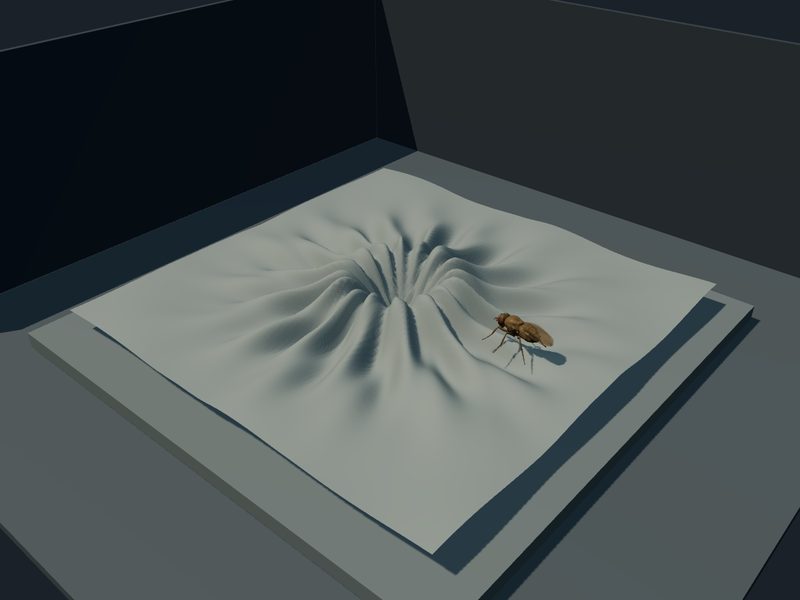
Recording pending publication. Follow along for the release.
Setup
- A procedural radial-fold height field in a neutral laboratory scene; three synthetic identities, A, B and C.
- Controls: Enroll scan, Blind test, and Run benchmark (six enrollment scans, six held-out tests, six paired disconnected-input controls).
- Each scan follows an experimenter-controlled trajectory of six fly-centered views; the displayed trace is coverage, not the fly's internal map.
- Cameras: Arena, Fly, Top, Surface.
Measurement
- Protocol retina32-lif-v1: recorded luminance columns only; surface labels, seeds, coordinates and identities never enter the neural probe.
- Each view runs 20 simulation steps on the frozen connectome; rates from 256 predefined visual-projection and descending cells form the feature vector, excluding direct retinal input cells.
- Recognition memory is a nearest-centroid classifier outside the connectome, compared with raw-luminance and retinal-spike baselines and disconnected-input controls.
Limitations
- The first pilot scored 2/6 downstream, 2/6 raw input, 1/6 retinal and 2/6 disconnected, against nominal chance of 1/3: no demonstrated recognition advantage.
- Procedural geometry only: no human scans, identity claims or clinical conclusions, and not a reproduction of the Stanford study.
- Positioning is guided, not an autonomous exploration policy; retention means reloading the external readout, not biological memory.