README
Courtship Chamber
experimentNo. 0069categoryLabs & sensesrecordingpendingdataCC BY 4.0
The fly is assigned the male role because the retained connectome is a male CNS. It executes a pre-programmed courtship ethogram toward a female in a 10 mm chamber while LC10a, pC1, pIP10 and DNa02 rates are measured.
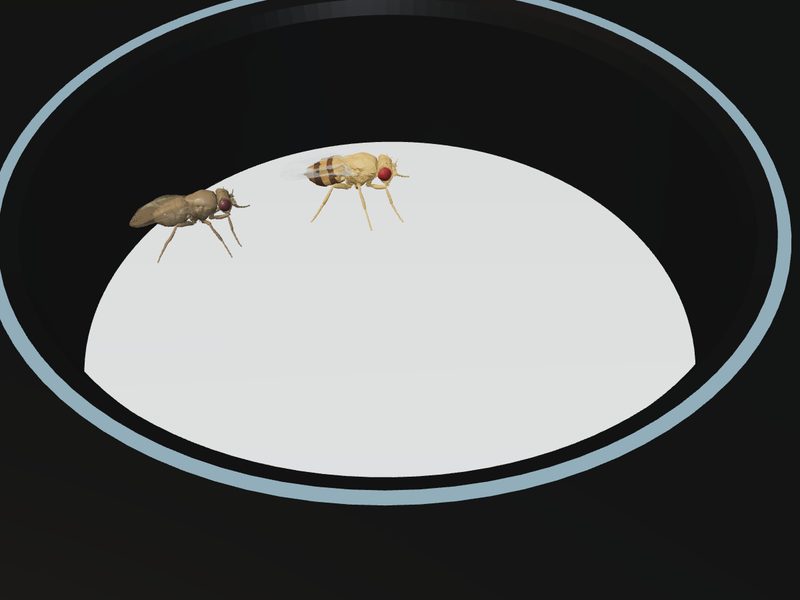
Recording pending publication. Follow along for the release.
Setup
- Eight stages over 90 s: pair introduced, orientation, following, tapping, wing extension and song, licking, attempted copulation, resumed orientation.
- The female does not accept and the timeline ends before copulation; body movement follows a pre-programmed, non-sexualized laboratory sequence.
- A programmed song display alternates pulse song (≈35 ms between pulses) and sine song (≈150 Hz) with an ethogram raster; it is viewport-only and never enters the retina.
- Cameras include chamber, overhead tracking view, pair close follow, male wing and forelegs, and male eye view.
Measurement
- The retina sees the moving female; measured LC10a, male pC1 cluster (contains P1), pIP10 and DNa02 rates are shown separately from the timeline-derived courtship index.
- Optional direct LC10a drive (applied only while the female lies within ±45° of the male's heading) and auditory drive are bounded and off by default.
- The male's body movement follows the classic ethogram on a pre-programmed timeline; weights are fixed.
Limitations
- The courtship index is computed from pre-programmed courting intervals, not from measured behavior.
- A 20 ms model step cannot carry the ~150–250 Hz song carrier; the auditory drive receives only the song envelope.
- Song bouts are a simplified synthetic pattern, not a recording.