README
Double-Slit Detector
experimentNo. 0050categoryLabs & sensesrecordingpendingrunsin browserdataCC BY 4.0
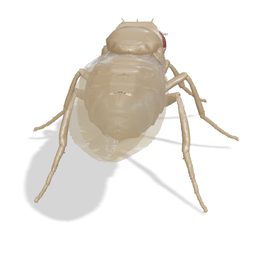
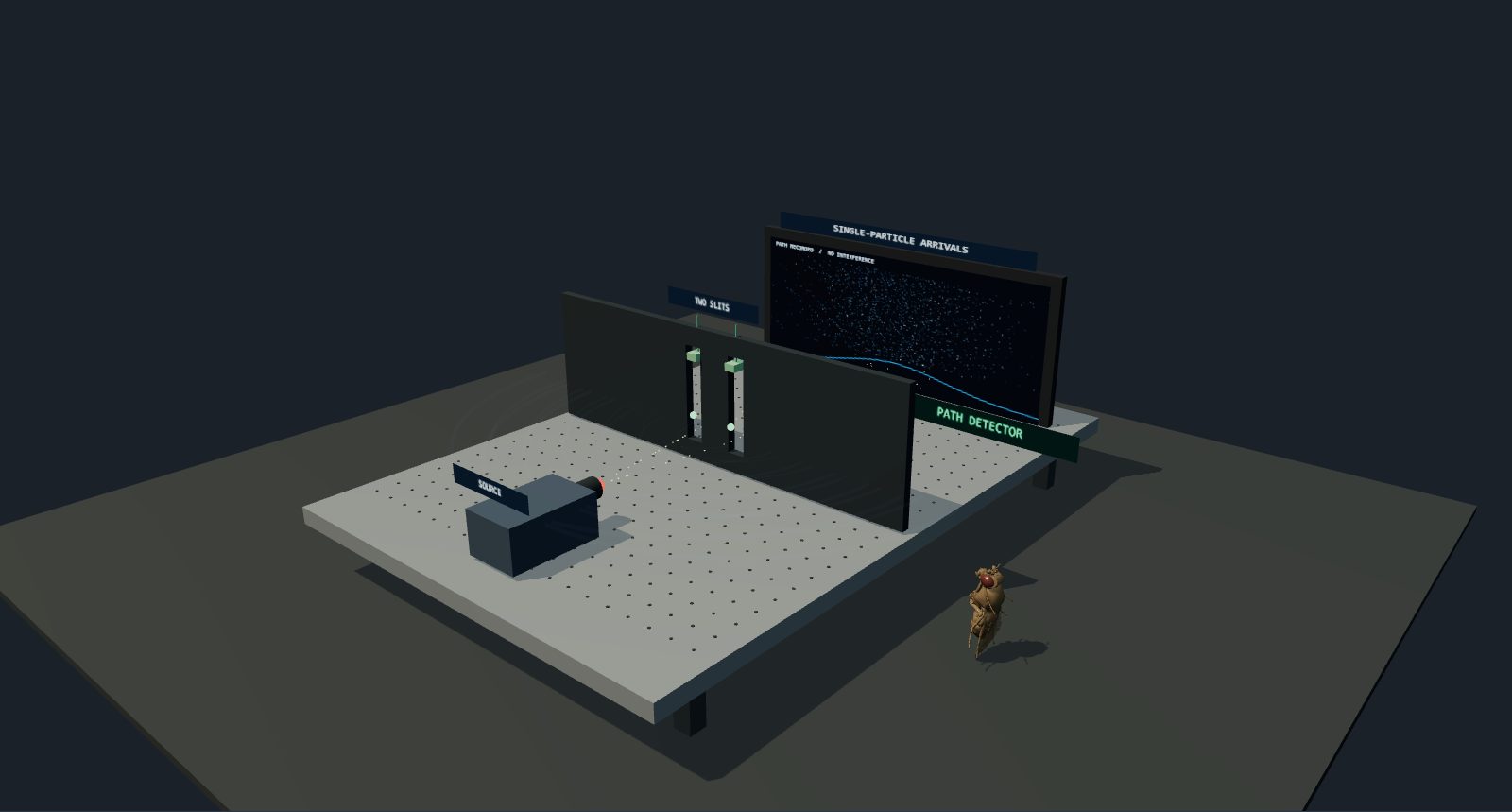
The fly stands beside a two-slit apparatus. Rotating the fly to face the apparatus enables a programmed which-path detector; turning it away disables the detector and restores the interference pattern.
Recording pending publication. Follow along for the release. Meanwhile, run it in your browser.
Interactive preview. Run this experiment in your browser with its cameras, the compound-eye inspector, wireframe views and a simulated neural panel. Run in browser
Setup
- A 60 s sequence that loops by default: particle source, two open slits, path detector, animated particle arrivals and a density curve.
- Controls: Fly rotation (saved, bounded to ±180°), Face detector and Turn away; changes apply while paused or playing.
- Cameras: Experiment / fly and screen, Screen / arrival pattern, Paths / overhead, Fly / detector switch.
Measurement
- Real retinal-only neural acquisition during playback; neural weights are fixed.
- The detector state follows the fly's rotation control; it is a programmed switch, not a neural output.
- Screen density is a normalized Gaussian envelope multiplied by 1 + visibility·cos(38x); visibility is 0 with the detector on and 1 with it off.
Limitations
- Eyesight or consciousness alone does not remove interference; the control switches a physical which-path detector in the rendered apparatus.
- Seeded samples illustrate arrivals; this is not a quantum solver or a calibrated quantum simulation, and the pattern is not a neural result.